One Team. Six Disciplines. No Slides.
From the electrician in building technology to the AI engineer. The breadth is no coincidence, but the point: modern plant engineers need all layers between cable and code. We deliver them from a single source.
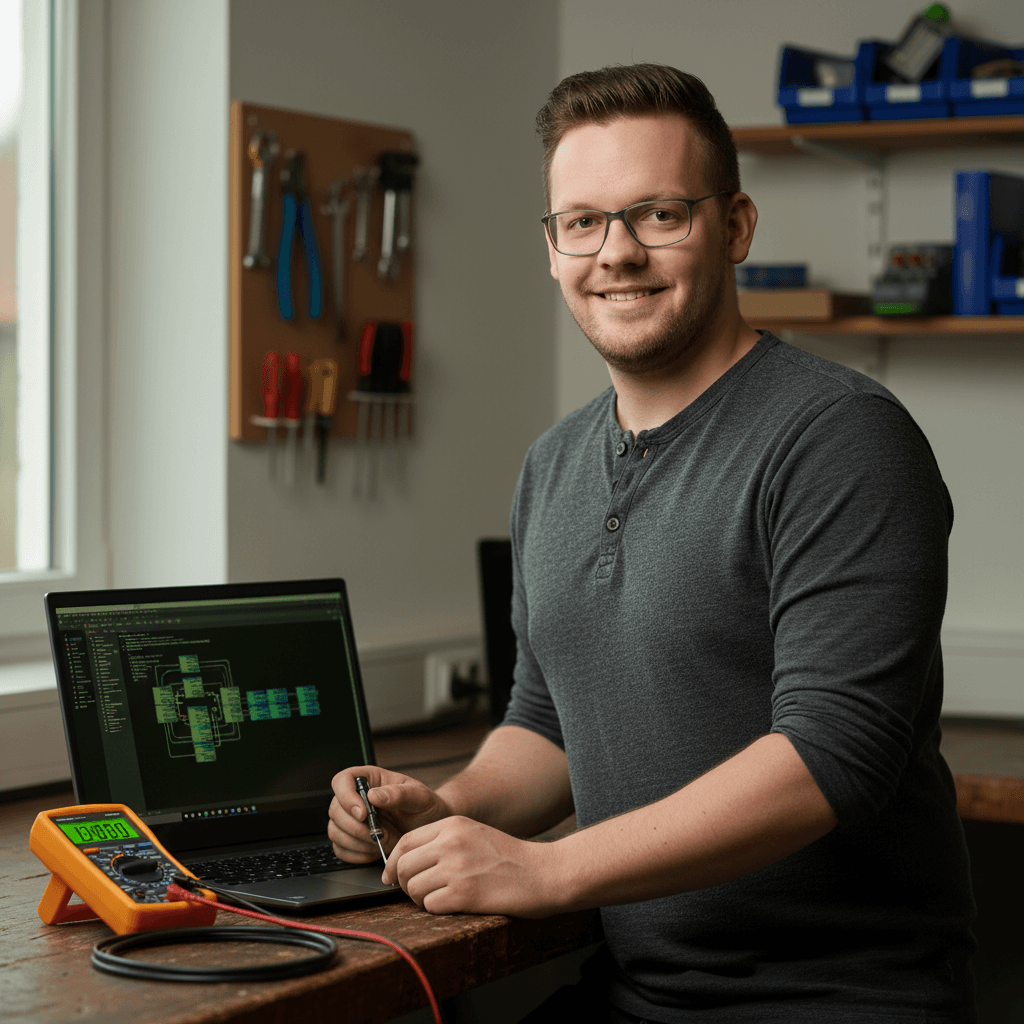
„From the Schaltschrank (control cabinet) to the language model.“
I build things that are supposed to work, so they work. That ranges from sub-distribution in new builds to AI that decides which conveyor belt starts next in the production hall. Sounds far apart, but it isn't. In the end, it's all signal processing — only the tools have different names.
Out of laziness. At Pacovis, I maintained food production plants for two years, and at some point, it was clear: maintenance plans are kept in Excel, wiring diagrams are PDFs on some computer, and if a sensor triggers, the hall calls me. That's not an automation problem, that's an information problem. I started writing small tools for myself. Tools became apps, apps became a language model that extracts control logic from specifications for me. Today, my tooling writes a good part of the code I typed myself five years ago. That's not magic, that's leverage.
Because the most interesting problems are here. In OWL, you have dairies, metal fabricators, plastics plants, food producers — all mid-sized businesses, all plant engineering, all a generation behind what's technically possible. If you give them a screen that shows their OEE live and immediately suggests a maintenance appointment, they'll talk about it for three weeks. Silicon Valley builds apps for people who already have apps. I build for people who still use clipboards.
Usually a CEO between 45 and 65 who knows he needs to do something but doesn't want a consultant selling him slides. He wants someone who stands in the hall, understands the system, and puts a solution on his table in the evening. I come in overalls or a shirt — depending on what the problem needs.
An SPS (PLC) knows states. An AI knows probabilities. If you couple both, you stop controlling and start anticipating. I work on crane systems at Scheffer — it's about load, path, dynamics, safety. The control system must remain deterministic; I don't let AI touch that. But around it? Condition classification from motor currents, maintenance prediction from bearing noises, specification parsing via LLM — these are the layers where you have massive leverage without anyone having to doubt operational safety. The SPS (PLC) does its job, the AI whispers to it in time.
That the solution still runs after I'm gone. Smart doesn't mean "new" — smart means "doesn't cause headaches after three years". I've seen too many systems in my life that relied on a script no one understood anymore. I don't do that. Every line is documented, every model reproducible, every app has a button the foreman in the hall can press.
Officially yes, §19 UStG is on the invoice. Practically, I bring in a network of three electrical engineers, two developers, and one automation specialist if the project size requires it. The client always sees me as the contact person — that's the deal. No project manager intermediary, no ticket hotline. My phone, my number.
Fair is when the client earns more after the project than they paid me. That's the only metric that counts. If I spend three days on a forecast and the client then saves 80,000 per year, my hours were a joke. If I need ten minutes for an outlet in the kitchen and charge a flat rate, also fair — both know the rules.
Ask about a project that went wrong. Everyone who's been around for a while has one. Anyone who doesn't mention one either lacks experience or honesty. I'd be happy to tell you about the small wastewater treatment plant at AST in 2018 that I couldn't get running for three nights — the control system worked, the pump too, but somewhere in the chain, a pressure switch was incorrectly parameterized. You learn more from three days of searching than from three months of operational use.
A handful of long-term clients, a platform that small mid-sized businesses can set up themselves — scan hall, AI suggestion, quote, delivery — and a team that knows that craftsmanship and software are the same, just with different hands. Growing big is not the goal. Being reliable is the goal.
„Smart doesn't mean 'new'. Smart means: it still runs in three years, even if I'm not here anymore."
From building technology apprentice to AI engineer.
Not a linear career path — but one that truly understood every layer between cable and code.
- Sep 2024 — heuteSPS-Programmierer / InbetriebnehmerScheffer Krantechnik GmbHKrananlagen
- März 2021 — Okt 2024Kleinunternehmer (Vorläufer von S3-Schmelz)Elektro SchmelzSelbstständig
- Aug 2021 — Juni 2022Elektroniker für Energie- und GebäudetechnikElektro Mariscal GmbH & Co. KGKundendienst
- Jan 2020 — Juli 2021Elektroniker für BetriebstechnikPacovis food solutions GmbHProduktionsanlagen
- Mai 2017 — Dez 2019Service-Monteur AbwassertechnikAST Frensing GmbH & Co. KGKleinkläranlagen
- Aug 2015 — Jan 2019Ausbildung Elektroniker Energie- und GebäudetechnikElektro Schulze · Carl-Miele-BerufskollegAusbildung
No email ping-pong. No sales loop.
Call, WhatsApp, or email — you reach us directly. Not an assistant, not a bot.
5 minutes for your quote. And then?
The generator below immediately gives you a price range and a PDF. If it fits, we'll call you back personally.